
Taxfiniti

#StartupSuccess

Startup Advisory: Strategic Guidance for Building Successful and Sustainable Businesses

Startup Advisory: Strategic Guidance for Building Successful and Sustainable Businesses

Startup advisory plays a crucial role in helping new businesses establish strong foundations, avoid costly mistakes, and achieve long-term growth. Starting a business is exciting, but it also involves legal, financial, operational, and strategic challenges that require expert guidance. From company registration and compliance to funding, business planning, and investor readiness, startup advisory services provide the professional support needed to turn an idea into a successful enterprise. In today’s competitive market, startups need more than passion and innovation—they need structure, planning, and expert decision-making. Startup advisory helps entrepreneurs move with clarity, confidence, and legal protection. What is Startup Advisory? Startup advisory refers to professional consulting services that help entrepreneurs and early-stage businesses manage legal, financial, strategic, and operational aspects of building and growing a company. It combines business strategy with practical execution support to reduce risks and improve success rates. Startup advisory commonly includes: Business registration and company formation Legal compliance and documentation Financial planning and budgeting Funding and investor preparation Business model validation Tax planning and compliance Intellectual property protection Partnership structuring Contract drafting and review Growth strategy and scaling support The goal is to help startups build a strong and legally secure business from the beginning. Why Startup Advisory is Important Many startups fail not because the idea is weak, but because the planning is incomplete. Common startup mistakes include: Choosing the wrong business structure Poor financial planning Weak founder agreements Lack of investor readiness Compliance failures Tax mismanagement Poor cash flow control Unclear growth strategy Startup advisory helps avoid these mistakes and saves both time and money. Benefits include: Better decision-making Strong legal protection Faster investor confidence Reduced operational risks Improved financial control Clear business direction Stronger compliance systems Sustainable long-term growth Company Registration and Business Structuring One of the first major decisions for a startup is choosing the right legal structure. Startup advisors help determine whether the business should be: Private Limited Company Limited Liability Partnership (LLP) Sole Proprietorship Partnership Firm One Person Company (OPC) Section 8 Company Startup recognized under government schemes Each structure affects taxation, funding opportunities, liability protection, and compliance responsibilities. Choosing the right structure is critical for future scalability. Founder Agreements and Legal Documentation Many startups begin with trust between founders, but legal clarity is essential. Startup advisory helps draft: Founder agreements Shareholding structures Partnership deeds Confidentiality agreements Employment contracts Vendor contracts Client service agreements Investor agreements ESOP planning documents Strong documentation prevents future disputes and protects ownership rights. Financial Planning and Budgeting Financial discipline is necessary from day one. Startup advisory includes: Initial budgeting Expense planning Revenue forecasting Cash flow management Profitability analysis Pricing strategy Burn rate control Funding requirement analysis Without financial planning, even promising startups can face early failure. Investor Readiness and Fundraising Raising capital is one of the biggest challenges for startups. Startup advisory helps with: Pitch deck preparation Financial projections Valuation strategy Due diligence readiness Investor agreements Angel investor support Venture capital preparation Term sheet review Professional preparation improves funding opportunities and protects founder interests. Tax Planning and Compliance Many startups ignore tax compliance until problems arise. Startup advisors ensure proper handling of: GST registration Income tax planning TDS compliance ROC filings Startup India recognition Annual compliance Audit preparation Regulatory reporting Early compliance prevents penalties and strengthens investor trust. Intellectual Property Protection Startups often depend on unique ideas, brand identity, and innovation. Advisory services help protect: Trademarks Brand names Logos Copyrights Patents Software rights Trade secrets Domain names Protecting intellectual property is essential for long-term competitive advantage. Business Model Validation and Growth Strategy A startup needs more than a product—it needs a sustainable business model. Startup advisors help with: Market validation Pricing strategy Customer acquisition planning Revenue model improvement Cost optimization Expansion strategy Scaling plans Operational systems improvement This helps startups move from survival mode to growth mode. Role of Startup Advisors Startup advisors work as strategic partners who support founders in making better decisions. They assist with: Legal guidance Financial strategy Investor preparation Business planning Risk management Compliance systems Corporate structuring Long-term scaling strategy Their role is to reduce uncertainty and increase business stability. Who Needs Startup Advisory? Startup advisory is useful for: First-time entrepreneurs Technology startups E-commerce businesses Service-based startups Family business expansion Manufacturing startups Fundraising companies Rapid growth businesses Any business in its early stage benefits from professional advisory support. Final Thoughts Startup advisory is not just consulting—it is a business survival and growth strategy. It helps entrepreneurs build legally strong, financially stable, and investor-ready companies from the very beginning. In a competitive market, startups that plan smartly grow faster and avoid unnecessary risks. Professional guidance helps founders focus on innovation while experts handle structure, compliance, and strategic planning. From registration to fundraising and scaling, startup advisory creates the roadmap for long-term success. A great startup begins with a strong idea—but it becomes successful through the right strategy, discipline, and expert support.  

Startup Advisory: Strategic Guidance for Building Successful and Sustainable Businesses Read More »

Startup Registration in India: Complete Guide for Entrepreneurs

  Starting a business in India has become easier with government initiatives and digital processes. Startup registration is the first legal step for entrepreneurs to establish their business and access various benefits, including tax exemptions, funding support, and compliance advantages. Proper registration not only provides legal identity but also builds credibility and trust among investors and customers. What is a Startup? A startup is a newly established business that aims to develop a unique product or service, often driven by innovation and scalability. In India, a business is recognized as a startup under the Startup India Initiative launched by the Government of India. To qualify as a startup: The entity should be less than 10 years old Annual turnover should not exceed ₹100 crore It must be working towards innovation, development, or improvement of products/services Importance of Startup Registration Registering your startup provides several advantages: Legal recognition of business Access to government schemes Tax benefits and exemptions Easier funding and investment opportunities Protection of intellectual property Credibility in the market Types of Business Structures for Startups Before registration, choosing the right business structure is crucial: 1. Sole Proprietorship Owned and managed by a single individual. Easy to start but has limited liability protection. 2. Partnership Firm Two or more individuals share profits and responsibilities. 3. Limited Liability Partnership (LLP) Offers limited liability with flexible management. 4. Private Limited Company Most preferred structure for startups due to scalability, funding ease, and limited liability. 5. One Person Company (OPC) Ideal for solo entrepreneurs who want corporate benefits. Step-by-Step Startup Registration Process 1. Choose Business Structure Select the suitable structure based on your business needs and future goals. 2. Name Approval Choose a unique business name and get it approved through the Ministry of Corporate Affairs (MCA) portal. 3. Obtain Digital Signature Certificate (DSC) Required for online filing of documents. 4. Apply for Director Identification Number (DIN) Mandatory for company directors. 5. Incorporation Filing Submit required documents such as Memorandum of Association (MOA) and Articles of Association (AOA). 6. Get Certificate of Incorporation Issued by the Registrar of Companies (ROC), confirming your business is legally registered. 7. Apply for Startup India Recognition Register on the Startup India portal to avail benefits. Documents Required for Startup Registration PAN card of founders Aadhaar card or identity proof Address proof Registered office address Passport-size photographs MOA and AOA (for companies) Startup India Benefits Registered startups can enjoy: 1. Tax Exemptions Income tax exemption for 3 consecutive years under certain conditions. 2. Funding Support Access to government-backed funds and venture capital. 3. Easy Compliance Reduced compliance burden and self-certification. 4. IPR Benefits Fast-track patent and trademark registration with reduced fees. 5. Networking Opportunities Access to startup events, incubators, and mentorship programs. GST Registration for Startups If your startup deals with goods or services beyond the threshold limit, GST registration is mandatory. It helps in: Legal tax compliance Input tax credit benefits Smooth interstate transactions Common Challenges in Startup Registration Choosing the right business structure Understanding legal requirements Documentation errors Delays in approval Compliance management Proper guidance from legal and financial experts can help overcome these challenges. Tips for Successful Startup Registration Conduct thorough market research Choose a unique and scalable business idea Maintain proper documentation Seek professional advice Plan finances carefully Stay compliant with laws and regulations Post-Registration Compliance After registration, startups must comply with: Filing annual returns Maintaining financial records Tax filings (Income Tax, GST) Board meetings and statutory audits Role of Technology in Startup Registration Digital platforms have simplified the registration process: Online filing through MCA portal E-signatures and digital documentation Startup India online recognition Automated compliance tools Why Legal Compliance Matters Legal compliance ensures: Smooth business operations Avoidance of penalties Investor trust Long-term sustainability Future of Startups in India India is one of the fastest-growing startup ecosystems globally. With government support, digital transformation, and increasing investment, startups have immense growth potential. Conclusion Startup registration is a crucial step in turning an idea into a successful business. It provides legal identity, access to benefits, and a strong foundation for growth. By following the correct process and maintaining compliance, entrepreneurs can build sustainable and scalable businesses in India’s dynamic market.  

Startup Registration in India: Complete Guide for Entrepreneurs Read More »

Startup Registration & Compliance in India: A Founder’s Legal Handbook

Startup Registration & Compliance in India: A Founder’s Legal Handbook

Starting a business in India is an exciting journey, but it also comes with important legal responsibilities. Proper startup registration and ongoing compliance are essential not just for legality, but also for building credibility, attracting investors, and ensuring long-term growth. This handbook provides a clear, expert-backed overview of how founders can navigate the legal landscape of startup registration and compliance in India. Understanding Startup Registration in India Startup registration refers to the process of legally establishing your business as a recognized entity under Indian law. Choosing the right structure is the first and most critical decision for any founder. The most common business structures in India include: Private Limited Company (Pvt Ltd) – Ideal for scalable startups and investor funding Limited Liability Partnership (LLP) – Suitable for small to medium businesses with flexibility One Person Company (OPC) – Best for solo founders Partnership Firm – Easy to set up but limited legal protection Sole Proprietorship – Simplest form but lacks separate legal identity Each structure has its own legal implications, taxation rules, and compliance requirements. For startups aiming for funding and scalability, a Private Limited Company is usually the preferred choice. Step-by-Step Startup Registration Process Registering a startup in India involves multiple steps and regulatory approvals. Here’s a simplified roadmap: Choose a Business Structure Evaluate your long-term goals, funding needs, and risk appetite. Obtain Digital Signature Certificate (DSC) Required for filing online documents. Apply for Director Identification Number (DIN) Mandatory for company directors. Name Approval Submit your preferred business name for approval through the MCA portal. Incorporation Filing File incorporation documents including MOA (Memorandum of Association) and AOA (Articles of Association). PAN & TAN Application Issued automatically after incorporation. Bank Account Opening Open a current account in the company’s name. Startup India Registration (Optional but Beneficial) Register under the Startup India initiative for tax benefits and recognition. Key Licenses and Registrations Depending on your business nature, additional registrations may be required: GST Registration – Mandatory for businesses crossing turnover thresholds Shops and Establishment License Import Export Code (IEC) FSSAI License – For food-related startups Trademark Registration – Protects brand identity Failing to obtain necessary licenses can lead to penalties and operational disruptions. Importance of Compliance for Startups Compliance refers to adhering to legal, regulatory, and financial requirements set by authorities. Many startups focus only on registration and ignore compliance, which can lead to serious consequences like fines, legal notices, or even company closure. Key compliance areas include: Annual ROC Filings Income Tax Returns GST Filings (Monthly/Quarterly) TDS Returns Statutory Audits Compliance ensures transparency and builds trust with stakeholders such as investors, banks, and customers. Startup India Benefits Registering under the Startup India scheme provides several advantages: Tax exemptions for eligible startups Faster patent and trademark processing Access to government funding schemes Self-certification for labor and environmental laws To qualify, startups must meet specific criteria such as innovation, scalability, and turnover limits. Common Legal Mistakes Founders Must Avoid Many startups face challenges due to avoidable legal errors. Here are some common mistakes: Choosing the wrong business structure Ignoring shareholder agreements Not maintaining proper financial records Missing compliance deadlines Failing to protect intellectual property Taking early legal advice can save significant time and costs in the future. Role of Legal Experts in Startup Growth Legal professionals play a crucial role in guiding startups through registration and compliance. From drafting agreements to ensuring regulatory adherence, expert legal support helps founders focus on business growth without legal risks. Key areas where legal experts assist: Business structuring Contract drafting Regulatory compliance Dispute resolution Intellectual property protection Cost of Startup Registration in India The cost varies depending on the business structure and professional fees. On average: Private Limited Company: ₹7,000 – ₹20,000+ LLP: ₹5,000 – ₹15,000 OPC: ₹6,000 – ₹15,000 Additional costs may include compliance fees, licensing charges, and legal consultation. Why Compliance is a Long-Term Investment Compliance is not just a legal obligation—it’s a strategic investment. Startups that maintain proper compliance: Gain investor confidence Avoid penalties and legal risks Build strong brand credibility Ensure smooth business operations In today’s competitive ecosystem, compliance can be a key differentiator between successful startups and those that fail. Conclusion Startup registration and compliance in India form the backbone of a successful business journey. From choosing the right structure to maintaining ongoing legal obligations, every step plays a vital role in shaping your startup’s future. Founders who prioritize legal clarity and compliance from the beginning are better positioned to scale, attract investments, and sustain long-term growth. If you’re planning to start your venture, taking a structured and legally sound approach will not only protect your business but also unlock growth opportunities in India’s dynamic startup ecosystem.  

Startup Registration & Compliance in India: A Founder’s Legal Handbook Read More »

Startup Registration in India: A Complete Guide for Aspiring Entrepreneurs

Startup Registration in India: A Complete Guide for Aspiring Entrepreneurs

 A Complete Guide for Aspiring Entrepreneurs   Starting a business in India is an exciting journey, but it comes with legal and administrative responsibilities. One of the most crucial steps for any entrepreneur is startup registration, which formalizes your business and ensures compliance with Indian laws. Proper registration not only protects your business legally but also enhances credibility with investors, clients, and government authorities. In this comprehensive guide, we’ll cover everything aspiring entrepreneurs need to know about startup registration in India, including types of business structures, the registration process, legal benefits, and expert tips to avoid common mistakes. Why Startup Registration Is Important Registering your startup in India is more than just a legal formality. It provides several key advantages: Legal Recognition – A registered startup is recognized as a legal entity, which helps in opening bank accounts, signing contracts, and entering partnerships. Investor Confidence – Investors are more likely to fund a business with proper registration and compliance. Intellectual Property Protection – Registered startups can protect their brand, patents, or unique products legally. Government Benefits – India’s Startup India initiative offers tax exemptions, funding support, and other incentives for registered startups. Credibility with Clients – Clients often prefer doing business with legally recognized entities, ensuring trust and professionalism. Types of Startup Registration in India Choosing the right business structure is the first step in startup registration. Each structure has its legal, financial, and tax implications. 1. Private Limited Company (Pvt Ltd) Most popular choice for startups due to limited liability protection. Requires a minimum of 2 directors and 2 shareholders. Can raise venture capital and issue equity shares. Compliant with Companies Act 2013 regulations. 2. Limited Liability Partnership (LLP) Combines the benefits of a partnership with limited liability protection. Requires at least 2 partners. Easy to manage with fewer compliance requirements than a private limited company. 3. Sole Proprietorship Owned and managed by a single individual. Simple and low-cost registration process. No separate legal entity; the owner is personally liable for business debts. 4. Partnership Firm Owned by 2 or more partners. Governed by the Indian Partnership Act 1932. Liability is shared among partners and is generally unlimited. Step-by-Step Process for Startup Registration Registering a startup involves multiple steps depending on the chosen business structure. Here’s a step-by-step guide for Private Limited Companies, the most common choice: Step 1: Obtain Digital Signature Certificate (DSC) Directors need a DSC for online registration on the Ministry of Corporate Affairs (MCA) portal. This ensures secure and verified submission of documents. Step 2: Acquire Director Identification Number (DIN) A DIN is mandatory for all directors. It verifies the identity of individuals managing the company. Step 3: Name Approval Propose a unique name for your startup and submit it to MCA for approval. Ensure the name complies with the Companies Act guidelines. Step 4: Drafting Memorandum and Articles of Association (MOA & AOA) MOA defines the company’s objectives, while AOA outlines its internal rules. These documents are crucial for legal recognition. Step 5: Filing Incorporation Forms Submit forms like SPICe+ along with necessary documents (identity proof, address proof, and MOA/AOA). MCA issues a Certificate of Incorporation (COI) after verification. Step 6: PAN and TAN Registration Obtain PAN (Permanent Account Number) and TAN (Tax Deduction and Collection Account Number) for taxation purposes. Step 7: GST Registration (If Applicable) Businesses with annual turnover exceeding ₹40 lakh (₹20 lakh for special states) must register for GST. Helps in legal compliance and claiming tax credits. Government Schemes and Incentives for Registered Startups India has introduced several initiatives to encourage entrepreneurship: Startup India Scheme – Offers tax exemptions, faster registration, and easier compliance. Tax Benefits – Registered startups can avail income tax exemptions under section 80-IAC for 3 consecutive years. Funding Support – Government-backed funds and incubators provide financial support to registered startups. Intellectual Property Benefits – Faster patent filing, trademark registration, and reduced fees for startups. Common Mistakes to Avoid During Startup Registration Even small errors in registration can cause delays or legal issues. Here are some common mistakes to avoid: Choosing an Unclear or Conflicting Business Name – Always check MCA records to ensure uniqueness. Incomplete Documentation – Ensure all identity proofs, address proofs, and MOA/AOA documents are correct. Ignoring Tax Compliance – Failing to register for GST or TAN can lead to penalties. Not Understanding Business Structure – Selecting the wrong structure can affect liability, taxes, and funding opportunities. Expert Tips for Smooth Startup Registration Consult a Professional – Chartered accountants or company secretaries can help avoid errors. Plan for Compliance – Keep track of annual filings, tax returns, and licenses. Stay Updated – Indian laws change frequently; ensure your startup stays compliant. Leverage Technology – Use online tools and MCA portal for faster registration. Conclusion Registering your startup in India is a critical step that lays the foundation for legal recognition, credibility, and growth. Whether you choose a Private Limited Company, LLP, Sole Proprietorship, or Partnership, following the proper registration process ensures compliance and access to government benefits. A well-registered startup attracts investors, builds customer trust, and opens doors to government schemes. By understanding the steps, avoiding common mistakes, and seeking expert guidance, aspiring entrepreneurs can focus on growing their business while leaving the legal formalities to professionals. Starting a business is exciting, but smart registration is what transforms your idea into a legitimate, thriving venture. Take the first step today and give your startup the legal and financial foundation it deserves.    

Startup Registration in India: A Complete Guide for Aspiring Entrepreneurs Read More »

How to Legally Register Your Startup: Expert Insights and Practical Tips
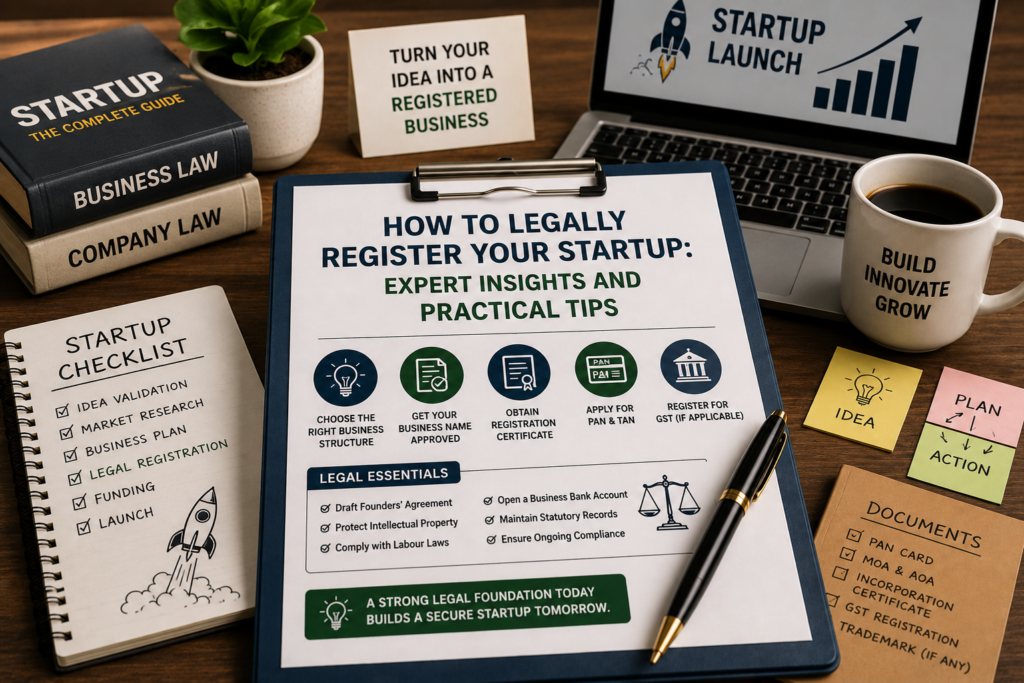
How to Legally Register Your Startup: Expert Insights and Practical Tips

Starting a business is an exciting journey, but legal registration is a critical step that every entrepreneur must undertake to ensure their startup operates smoothly and remains compliant with regulations. Proper registration not only protects your business legally but also opens doors to funding, government incentives, and market credibility. In this guide, we’ll provide expert insights and practical tips on how to legally register your startup in India. Why Startup Registration Matters Registering your startup is more than a formality—it establishes your business as a legal entity and protects your interests. Key benefits include: Legal Recognition – Grants your business a formal identity under Indian law. Access to Funding – Investors, banks, and venture capitalists prefer registered entities. Tax Benefits – Enables eligibility for startup-specific tax incentives and exemptions. Brand Protection – Secures your business name and intellectual property rights. Regulatory Compliance – Ensures your business operates within legal frameworks, avoiding fines and penalties. Step 1: Decide the Right Business Structure Choosing the correct legal structure is crucial for liability, taxation, and operations. Common options for startups in India include: Private Limited Company (Pvt Ltd) Suitable for high-growth startups seeking investment. Offers limited liability protection. Requires a minimum of 2 directors and 2 shareholders. Limited Liability Partnership (LLP) Combines partnership flexibility with limited liability protection. Ideal for small to medium-sized businesses. One Person Company (OPC) Best for solo entrepreneurs. Offers limited liability while maintaining simpler compliance than Pvt Ltd. Partnership Firm Simple to set up, but partners bear unlimited liability. Suitable for small, low-risk ventures. Step 2: Obtain Digital Signature Certificate (DSC) and Director Identification Number (DIN) For registering a Pvt Ltd or OPC, the following are mandatory: Digital Signature Certificate (DSC) – Required for online filing and signing official documents. Director Identification Number (DIN) – Unique ID for directors, ensuring accountability. These can be obtained from government-approved agencies and are essential for compliance. Step 3: Reserve Your Startup Name Choosing a unique and relevant name is critical. Use the MCA’s RUN (Reserve Unique Name) portal to: Check name availability. Ensure the name aligns with your business identity and branding. Avoid duplication and legal disputes in the future. Tips: Keep the name simple, relevant, and reflective of your business vision. Step 4: Prepare Key Documents Proper documentation is essential for smooth registration. Commonly required documents include: Incorporation Form – Specific to the chosen structure (SPICe+ for Pvt Ltd/OPC). Proof of Identity – PAN, Aadhaar, or passport of directors. Proof of Address – Residential proof of directors and registered office address. MoA and AoA – Memorandum of Association and Articles of Association for Pvt Ltd companies. Ensuring accurate and complete documentation reduces delays in the registration process. Step 5: Register with Government Authorities For Pvt Ltd and OPC, registration is done online via the MCA (Ministry of Corporate Affairs) portal using SPICe+ forms. The process typically includes: Name approval via RUN. Filing SPICe+ (INC-32) for incorporation. Filing eMoA and eAoA. Applying for PAN and TAN for the business. For LLPs, the process includes LLP Agreement filing, DIN allotment, and LLP incorporation form submission. Step 6: Obtain Mandatory Licenses and Registrations Depending on your startup’s business activities, additional registrations may be required: GST Registration – Mandatory if turnover exceeds ₹40 lakhs (or ₹20 lakhs in certain states) or for inter-state supply of goods/services. Professional Tax Registration – Applicable in certain states for employees. Shops & Establishment License – Required for physical business locations. Import Export Code (IEC) – For startups involved in international trade. FSSAI License – Mandatory for food-related businesses. Consult an expert to identify all applicable licenses and ensure full compliance. Step 7: Open a Bank Account and Maintain Compliance After incorporation, open a current bank account in the company’s name. Additionally, maintain regular compliance with: Annual filings with MCA. Income tax filings. GST returns and audits (if applicable). Consistent compliance avoids penalties and establishes credibility with investors and partners. Expert Tips for a Smooth Registration Process Seek Professional Guidance – Engage a CA or legal expert to avoid errors and streamline the process. Plan Your Structure Early – Choosing the right legal entity at the start saves future restructuring challenges. Document Everything – Maintain copies of all filings, approvals, and communications for reference. Keep Track of Deadlines – Compliance deadlines, such as annual filings, are strict and penalties apply for delays. Leverage Government Incentives – Register as a startup under the Startup India Scheme to access tax benefits, funding, and incubation support. Common Challenges and How to Overcome Them Name Rejection – Avoid generic names and ensure uniqueness. Incomplete Documentation – Double-check IDs, addresses, and office proofs. Delays in Approval – Track application status online and follow up with authorities if needed. Complex Licensing Requirements – Consult professionals familiar with sector-specific regulations. Conclusion Registering a startup is a crucial step toward legal recognition, operational stability, and future growth. By following a structured process—choosing the right business structure, preparing documents accurately, obtaining necessary licenses, and maintaining compliance—entrepreneurs can focus on innovation and scaling their business. With expert guidance and careful planning, startup registration becomes a smooth, efficient, and strategic step in building a successful venture. Proper legal registration not only protects your business but also enhances credibility, attracts investors, and ensures long-term sustainability. Take the time to do it right—the foundation of a successful startup begins with proper registration.    

How to Legally Register Your Startup: Expert Insights and Practical Tips Read More »

Startup Advisory Unlocked: Build Smart, Scale Faster

Startup Advisory Unlocked: Build Smart, Scale Faster

In today’s rapidly evolving business landscape, launching a startup is easier than ever — but building a successful one requires far more than just a great idea. Founders must navigate challenges across strategy, finance, compliance, technology, branding, hiring, fundraising, and market expansion. This is where Startup Advisory becomes a powerful catalyst, helping early-stage businesses grow smarter and scale faster. This article breaks down how strategic advisory can transform a raw idea into a sustainable, high-growth company. 1. Why Startup Advisory Matters Every startup begins with passion, but not all begin with structure. Advisory services help founders: Validate business ideas Build a strong operational and financial foundation Avoid costly early-stage mistakes Make data-driven decisions Accelerate growth with expert insights Advisors act as partners, guiding startups through each critical stage of their journey. 2. From Concept to Execution — Building Smart From Day One A successful startup is built on clarity, structure, and strategy. Advisory services help with: ✔ Business Model Validation Experts evaluate whether the idea is viable, scalable, and profitable in the long run. ✔ Market & Competitor Analysis Understanding customer needs and competitor gaps ensures a strong market entry strategy. ✔ Financial & Revenue Planning Advisors help forecast revenue, manage cash flow, and create sustainable financial models. ✔ Legal & Compliance Structure Startups often overlook this, but advisory ensures the right: entity formation registrations contracts taxation strategies risk management Starting right saves major issues later. 3. Strong Systems for Strong Growth A scalable business is built on systems, not guesswork. Startup advisory helps create: ✔ Operational Systems Efficient workflows, SOPs, onboarding systems, and automation. ✔ Tech Enablement Choosing the right tools for CRM, project management, accounting, marketing, and analytics. ✔ Branding & Positioning Guidance on brand identity, messaging, and digital presence that resonates with your audience. ✔ Talent & Team Building Support in hiring, structuring roles, and building a culture that drives performance. These foundations allow the startup to grow without breaking internally. 4. Scale Faster With Strategic Mentorship Growth requires insight, experience, and direction. Advisors provide: ✔ Go-to-Market (GTM) Strategy How to launch, acquire customers, and win early traction. ✔ Investor & Fundraising Support Pitch deck creation, investor connections, valuation guidance, and fundraising strategy. ✔ Performance Tracking KPIs, dashboards, and metrics that help founders make data-backed decisions. ✔ Business Expansion Roadmaps When and how to expand: to new markets to new products to new customer segments This ensures the startup grows sustainably, not blindly. 5. Avoiding the Mistakes Most Startups Make Most early-stage companies fail not because of bad ideas, but because of: weak financial planning poor product-market fit zero documentation unclear branding lack of legal compliance scaling too early or too late reactive decision-making A professional advisory service protects the startup from these pitfalls, turning uncertainty into clarity and confidence. 6. Building a Future-Ready Startup With global competition rising and markets shifting quickly, startups must be adaptable and resilient. Advisors help founders: innovate continuously build long-term strategy adopt future-ready technology create sustainable business models stay compliant as they grow This blend of strategic planning and practical execution becomes the startup’s competitive advantage. Conclusion Startup Advisory isn’t just guidance — it’s a growth engine.With the right experts, founders gain clarity, structure, and strategic direction to build smarter and scale faster. Whether it’s financial modeling, legal compliance, market analysis, or scaling strategy, advisory services give startups the support they need to transform ideas into successful, high-impact businesses. In a world where speed matters but direction matters more, a strong advisory partner ensures you grow confidently, strategically, and sustainably.

Startup Advisory Unlocked: Build Smart, Scale Faster Read More »