Taxfiniti

#StartupFunding

Startup Registration in India: Complete Guide for Entrepreneurs

  Starting a business in India has become easier with government initiatives and digital processes. Startup registration is the first legal step for entrepreneurs to establish their business and access various benefits, including tax exemptions, funding support, and compliance advantages. Proper registration not only provides legal identity but also builds credibility and trust among investors and customers. What is a Startup? A startup is a newly established business that aims to develop a unique product or service, often driven by innovation and scalability. In India, a business is recognized as a startup under the Startup India Initiative launched by the Government of India. To qualify as a startup: The entity should be less than 10 years old Annual turnover should not exceed ₹100 crore It must be working towards innovation, development, or improvement of products/services Importance of Startup Registration Registering your startup provides several advantages: Legal recognition of business Access to government schemes Tax benefits and exemptions Easier funding and investment opportunities Protection of intellectual property Credibility in the market Types of Business Structures for Startups Before registration, choosing the right business structure is crucial: 1. Sole Proprietorship Owned and managed by a single individual. Easy to start but has limited liability protection. 2. Partnership Firm Two or more individuals share profits and responsibilities. 3. Limited Liability Partnership (LLP) Offers limited liability with flexible management. 4. Private Limited Company Most preferred structure for startups due to scalability, funding ease, and limited liability. 5. One Person Company (OPC) Ideal for solo entrepreneurs who want corporate benefits. Step-by-Step Startup Registration Process 1. Choose Business Structure Select the suitable structure based on your business needs and future goals. 2. Name Approval Choose a unique business name and get it approved through the Ministry of Corporate Affairs (MCA) portal. 3. Obtain Digital Signature Certificate (DSC) Required for online filing of documents. 4. Apply for Director Identification Number (DIN) Mandatory for company directors. 5. Incorporation Filing Submit required documents such as Memorandum of Association (MOA) and Articles of Association (AOA). 6. Get Certificate of Incorporation Issued by the Registrar of Companies (ROC), confirming your business is legally registered. 7. Apply for Startup India Recognition Register on the Startup India portal to avail benefits. Documents Required for Startup Registration PAN card of founders Aadhaar card or identity proof Address proof Registered office address Passport-size photographs MOA and AOA (for companies) Startup India Benefits Registered startups can enjoy: 1. Tax Exemptions Income tax exemption for 3 consecutive years under certain conditions. 2. Funding Support Access to government-backed funds and venture capital. 3. Easy Compliance Reduced compliance burden and self-certification. 4. IPR Benefits Fast-track patent and trademark registration with reduced fees. 5. Networking Opportunities Access to startup events, incubators, and mentorship programs. GST Registration for Startups If your startup deals with goods or services beyond the threshold limit, GST registration is mandatory. It helps in: Legal tax compliance Input tax credit benefits Smooth interstate transactions Common Challenges in Startup Registration Choosing the right business structure Understanding legal requirements Documentation errors Delays in approval Compliance management Proper guidance from legal and financial experts can help overcome these challenges. Tips for Successful Startup Registration Conduct thorough market research Choose a unique and scalable business idea Maintain proper documentation Seek professional advice Plan finances carefully Stay compliant with laws and regulations Post-Registration Compliance After registration, startups must comply with: Filing annual returns Maintaining financial records Tax filings (Income Tax, GST) Board meetings and statutory audits Role of Technology in Startup Registration Digital platforms have simplified the registration process: Online filing through MCA portal E-signatures and digital documentation Startup India online recognition Automated compliance tools Why Legal Compliance Matters Legal compliance ensures: Smooth business operations Avoidance of penalties Investor trust Long-term sustainability Future of Startups in India India is one of the fastest-growing startup ecosystems globally. With government support, digital transformation, and increasing investment, startups have immense growth potential. Conclusion Startup registration is a crucial step in turning an idea into a successful business. It provides legal identity, access to benefits, and a strong foundation for growth. By following the correct process and maintaining compliance, entrepreneurs can build sustainable and scalable businesses in India’s dynamic market.  

Startup Registration in India: Complete Guide for Entrepreneurs Read More »

Startup Advisory Unlocked: Build Smart, Scale Faster

Startup Advisory Unlocked: Build Smart, Scale Faster

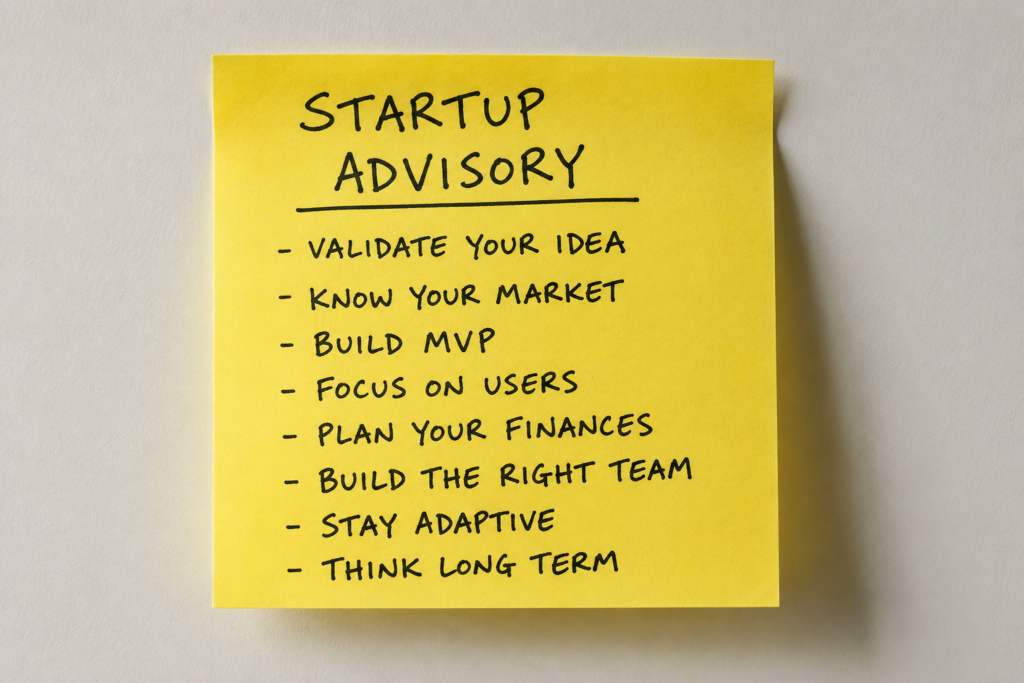
In today’s rapidly evolving business landscape, launching a startup is easier than ever — but building a successful one requires far more than just a great idea. Founders must navigate challenges across strategy, finance, compliance, technology, branding, hiring, fundraising, and market expansion. This is where Startup Advisory becomes a powerful catalyst, helping early-stage businesses grow smarter and scale faster. This article breaks down how strategic advisory can transform a raw idea into a sustainable, high-growth company. 1. Why Startup Advisory Matters Every startup begins with passion, but not all begin with structure. Advisory services help founders: Validate business ideas Build a strong operational and financial foundation Avoid costly early-stage mistakes Make data-driven decisions Accelerate growth with expert insights Advisors act as partners, guiding startups through each critical stage of their journey. 2. From Concept to Execution — Building Smart From Day One A successful startup is built on clarity, structure, and strategy. Advisory services help with: ✔ Business Model Validation Experts evaluate whether the idea is viable, scalable, and profitable in the long run. ✔ Market & Competitor Analysis Understanding customer needs and competitor gaps ensures a strong market entry strategy. ✔ Financial & Revenue Planning Advisors help forecast revenue, manage cash flow, and create sustainable financial models. ✔ Legal & Compliance Structure Startups often overlook this, but advisory ensures the right: entity formation registrations contracts taxation strategies risk management Starting right saves major issues later. 3. Strong Systems for Strong Growth A scalable business is built on systems, not guesswork. Startup advisory helps create: ✔ Operational Systems Efficient workflows, SOPs, onboarding systems, and automation. ✔ Tech Enablement Choosing the right tools for CRM, project management, accounting, marketing, and analytics. ✔ Branding & Positioning Guidance on brand identity, messaging, and digital presence that resonates with your audience. ✔ Talent & Team Building Support in hiring, structuring roles, and building a culture that drives performance. These foundations allow the startup to grow without breaking internally. 4. Scale Faster With Strategic Mentorship Growth requires insight, experience, and direction. Advisors provide: ✔ Go-to-Market (GTM) Strategy How to launch, acquire customers, and win early traction. ✔ Investor & Fundraising Support Pitch deck creation, investor connections, valuation guidance, and fundraising strategy. ✔ Performance Tracking KPIs, dashboards, and metrics that help founders make data-backed decisions. ✔ Business Expansion Roadmaps When and how to expand: to new markets to new products to new customer segments This ensures the startup grows sustainably, not blindly. 5. Avoiding the Mistakes Most Startups Make Most early-stage companies fail not because of bad ideas, but because of: weak financial planning poor product-market fit zero documentation unclear branding lack of legal compliance scaling too early or too late reactive decision-making A professional advisory service protects the startup from these pitfalls, turning uncertainty into clarity and confidence. 6. Building a Future-Ready Startup With global competition rising and markets shifting quickly, startups must be adaptable and resilient. Advisors help founders: innovate continuously build long-term strategy adopt future-ready technology create sustainable business models stay compliant as they grow This blend of strategic planning and practical execution becomes the startup’s competitive advantage. Conclusion Startup Advisory isn’t just guidance — it’s a growth engine.With the right experts, founders gain clarity, structure, and strategic direction to build smarter and scale faster. Whether it’s financial modeling, legal compliance, market analysis, or scaling strategy, advisory services give startups the support they need to transform ideas into successful, high-impact businesses. In a world where speed matters but direction matters more, a strong advisory partner ensures you grow confidently, strategically, and sustainably.

Startup Advisory Unlocked: Build Smart, Scale Faster Read More »