
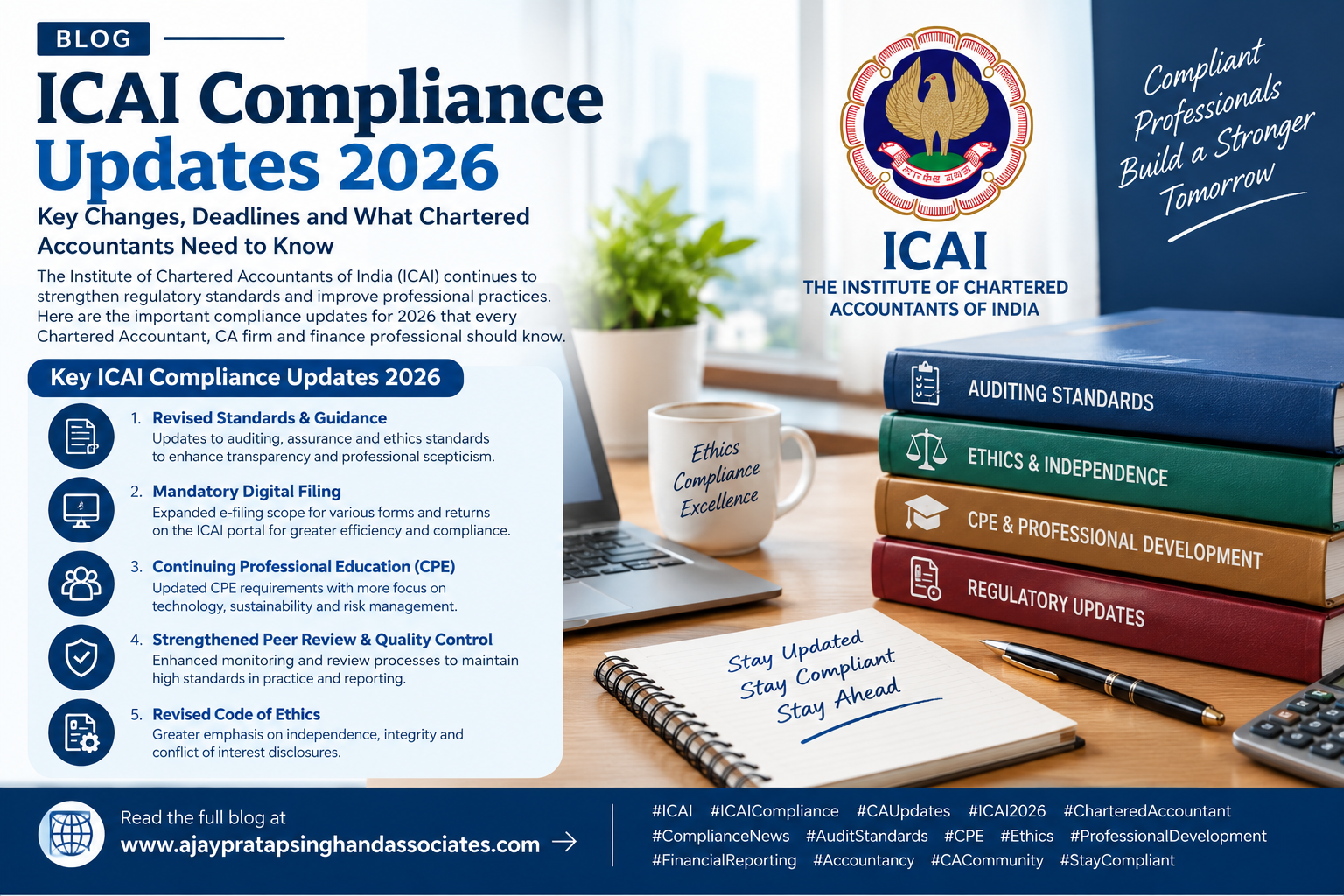
ICAI Compliance Updates 2026: Important Rules, Professional Requirements and Key Changes
ICAI Compliance Updates 2026 are important for Chartered Accountants (CAs), accounting professionals, audit firms, business owners and finance teams who need to stay informed about professional requirements, regulatory developments and changes affecting accounting and audit practices in India.
The Institute of Chartered Accountants of India (ICAI) plays a significant role in regulating the Chartered Accountancy profession, issuing professional guidance, administering examinations and supporting members through technical resources and compliance-related announcements. Keeping track of its official notifications helps professionals identify relevant deadlines, review procedural requirements and maintain proper documentation.
In 2026, professionals should pay attention to ICAI announcements relating to member requirements, the Members Eligibility Criteria (MEF), digital systems such as the Unique Document Identification Number (UDIN) portal, professional ethics, audit documentation and relevant regulatory developments. Corporate compliance changes notified by the Ministry of Corporate Affairs (MCA) should also be monitored separately because they may create obligations for companies and limited liability partnerships.
This article explains the important areas to monitor under ICAI Compliance Updates 2026 and offers practical steps for CAs, businesses and accounting teams.
Key Takeaways
- Regularly check official ICAI announcements and notifications for new requirements and deadlines.
- Review MEF-related announcements if you are a practising CA or an eligible member of a firm.
- Follow applicable UDIN requirements and ensure that document details are accurate.
- Maintain appropriate audit working papers, supporting evidence and professional records.
- Monitor relevant MCA notifications separately from ICAI announcements.
- Confirm the applicability and effective date of each update before changing an existing compliance process.
1. Understanding ICAI Compliance Updates 2026
ICAI compliance-related updates may concern different aspects of professional practice. Not every announcement introduces a new legal obligation. Some announcements provide administrative information, examination schedules, professional guidance, application deadlines or changes to digital services.
Chartered Accountants should identify the category of each update before deciding what action is required.
Professional and membership-related requirements
Members should monitor announcements concerning membership, practice-related requirements, professional development and eligibility for specific professional activities.
Where an announcement specifies a submission deadline, members should check the eligibility conditions, prescribed documents and official submission process.
Accounting and auditing guidance
Accounting and audit professionals should monitor applicable standards, implementation guidance and technical announcements relevant to their assignments.
The correct treatment depends on the entity, applicable reporting framework, relevant financial year and the specific standard or regulation involved.
Digital compliance systems
Digital systems such as the UDIN portal support professional processes and document verification. Members should remain familiar with the current portal requirements and verify that the information submitted is correct.
For the latest announcements, visit the official ICAI website at https://www.icai.org/.
2. ICAI Member and Firm-Related Updates
Membership and firm-related announcements can be important for practising Chartered Accountants and audit firms.
One area to monitor is the Multipurpose Empanelment Form (MEF). ICAI publishes announcements relating to MEF submissions and related deadlines. Members should read the current notice to determine whether it applies to them and whether any action is required.
For example, ICAI published an announcement on 14 October 2026 concerning the last opportunity for submission of MEF 2026–27. Members concerned should refer to the official announcement for the applicable instructions and deadline.
Practical steps for members
- Review the latest MEF announcement and eligibility requirements.
- Check that membership and firm information is accurate.
- Keep supporting records available before submitting information.
- Retain acknowledgements and confirmation records.
- Monitor subsequent announcements for clarifications or changes.
Do not rely on an old deadline or previous year’s process without checking the latest official notice.
3. UDIN Compliance and Document Verification
The Unique Document Identification Number (UDIN) system is an important part of professional document verification for Chartered Accountants.
ICAI’s UDIN portal allows members to generate and manage UDINs for documents covered by the applicable requirements. The purpose is to support verification and reduce the risk of misuse of professional credentials.
During 2026, updates to UDIN portal categories were also reported, making it important for members to review the current portal options and applicable instructions rather than relying on older procedures.
Good practices for UDIN compliance
Verify document details: Ensure that the information entered matches the underlying document.
Follow applicable requirements: Confirm whether a UDIN is required for the specific document and professional assignment.
Maintain supporting records: Retain relevant documents and workpapers according to applicable professional and legal requirements.
Check portal instructions: Use the current ICAI UDIN portal guidance when selecting categories or completing the process.
Avoid sharing credentials: Protect login information and professional access details.
Members should consult the official ICAI website and UDIN portal for the latest instructions.
4. Audit Documentation and Professional Ethics
Audit documentation is essential to demonstrate the work performed, evidence considered and conclusions reached during an engagement.
Professional responsibilities extend beyond completing an audit report. Chartered Accountants must comply with applicable auditing standards, ethical requirements and relevant laws.
Why audit working papers matter
Working papers may help document:
- The audit procedures performed.
- The evidence obtained and evaluated.
- Significant matters identified during the engagement.
- Professional judgments and conclusions.
- The basis for material findings and reporting decisions.
The specific documentation requirements depend on the applicable standards and circumstances of the engagement.
Professional conduct and due diligence
CAs should exercise appropriate professional care, maintain independence where required, and evaluate evidence critically. Records should accurately reflect the work performed.
ICAI’s legal and disciplinary updates provide examples of professional conduct issues considered under the Chartered Accountants Act, 1949 and applicable professional requirements. These updates can help members understand the importance of due diligence, documentation and ethical conduct.
Professionals should read individual disciplinary decisions in context and should not assume that every case creates a new general rule.
5. ICAI Updates and Corporate Compliance Requirements
Businesses often use the phrase “ICAI compliance” to describe a broad range of accounting, tax, audit and corporate obligations. However, different authorities administer different requirements.
ICAI regulates the profession and issues professional guidance within its statutory role. The Ministry of Corporate Affairs administers important company and LLP-related requirements under the relevant legislation and rules. Other obligations may arise under income tax, GST, labour laws and sector-specific regulations.
Companies Compliance Facilitation Scheme, 2026
A relevant corporate compliance development in 2026 is the Companies Compliance Facilitation Scheme, 2026 (CCFS-2026), listed by ICAI’s Corporate Laws Committee among its corporate law updates.
Businesses should consult the applicable MCA notification and official scheme documents to confirm eligibility, filing requirements, fees, relief available and the period during which the scheme operates.
It is important not to treat a corporate scheme as a general ICAI membership rule. Its applicability depends on the actual provisions and the company’s circumstances.
How businesses should respond
- Identify the authority responsible for each compliance obligation.
- Review the relevant notification or statutory provision.
- Check the effective date and eligibility conditions.
- Assess the company’s outstanding filings and records.
- Obtain professional advice before relying on a scheme or exemption.
Businesses can use official resources from ICAI and MCA to verify the requirements applicable to their situation.
6. Accounting Standards and Financial Reporting
Accounting standards influence how transactions are recognised, measured, presented and disclosed in financial statements.
CAs and finance teams should monitor official announcements and applicable implementation guidance to determine whether a particular standard or amendment affects their reporting responsibilities.
Areas that deserve regular review
Revenue recognition: Review whether revenue is recorded in accordance with the applicable reporting framework and relevant requirements.
Financial instruments: Assess the applicable recognition, measurement and disclosure rules where relevant.
Related-party transactions: Ensure that relevant relationships and transactions are identified and appropriately documented.
Provisions and contingencies: Review whether obligations, uncertainties and disclosures are addressed under the applicable standards.
Financial statement disclosures: Check that required information is complete, accurate and consistent with the applicable framework.
Not every accounting standard applies to every entity. Applicability depends on factors such as the entity type, reporting framework and relevant statutory provisions.
7. Tax and GST Compliance: What Professionals Should Monitor
ICAI members frequently advise clients on tax and GST matters. However, tax deadlines and legal obligations are generally established through the relevant legislation, rules, notifications and official directions rather than by ICAI announcements alone.
For that reason, professionals should monitor the relevant government authorities in addition to ICAI.
Income tax compliance
Review applicable return-filing requirements, tax audit obligations, advance tax, withholding tax and other requirements based on the taxpayer’s circumstances and the relevant assessment year.
GST compliance
Businesses should check applicable registration, invoicing, return filing, payment, reconciliation and input tax credit requirements under the current GST framework.
Reconciliation and documentation
Regular reconciliation of accounting records with tax returns and supporting documents can help identify inconsistencies before filing or responding to a notice.
Because deadlines and statutory requirements may change, always verify the latest official instructions before taking action.
8. A Practical Compliance Checklist for CAs and Businesses
A structured compliance calendar helps reduce missed deadlines and improves accountability.
Monthly review
- Review upcoming statutory filing dates.
- Reconcile relevant accounting and tax records.
- Verify supporting documentation for important transactions.
- Check applicable portal notices and updates.
Quarterly review
- Review tax and GST compliance applicable to the business.
- Assess pending notices and responses.
- Check the status of professional assignments and required documentation.
- Update the compliance tracker for changes in law or procedure.
Annual review
- Review annual financial statements and audit requirements.
- Confirm applicable tax return and statutory filing obligations.
- Check relevant membership, firm and professional requirements.
- Review internal controls and document retention practices.
- Update the compliance calendar for the next financial year.
This checklist is a general framework. The actual requirements and frequency should be adapted to the entity, industry, applicable law and professional assignment.
9. Where to Find Official ICAI Compliance Updates
Using reliable sources is essential when interpreting a new rule or notification.
The following official resources can help professionals verify announcements and requirements:
ICAI official website: https://www.icai.org/ — announcements, notifications, member information and other institutional updates.
ICAI announcements: https://icai.org/category/announcements — announcements concerning deadlines, professional matters, examinations and other updates.
ICAI notifications: https://www.icai.org/category/notifications — formal notifications and related information.
ICAI Corporate Laws Committee: https://corporatelaws.icai.org/ — corporate law developments and resources relevant to members.
India Code: https://www.indiacode.nic.in/ — central legislation and statutory references.
Ministry of Corporate Affairs: https://www.mca.gov.in/ — official corporate filing services, notifications and company law information.
Before acting on an update, confirm its publication date, effective date, applicability and any subsequent amendment or clarification.
Frequently Asked Questions
1. What are ICAI Compliance Updates 2026?
They refer to announcements, notifications, professional guidance and other developments relevant to Chartered Accountants and accounting professionals during 2026. Their practical effect depends on the subject and the official instructions.
2. Where can I check the latest ICAI announcements?
Visit https://www.icai.org/ and review the official announcements and notifications sections. Always consult the underlying notice for details.
3. Are ICAI updates applicable to every business?
No. Some updates relate specifically to ICAI members, students or firms. Businesses may be affected indirectly through accounting, audit or professional services, while corporate and tax obligations may arise from separate laws and authorities.
4. Why is UDIN important for Chartered Accountants?
UDIN supports verification of professional documents covered by ICAI’s applicable requirements. Members should follow current portal instructions and confirm whether a particular document requires a UDIN.
5. How can businesses avoid missing compliance deadlines?
Maintain a compliance calendar, assign responsibility for each task, retain supporting documents and regularly review official notifications. Seek professional advice where applicability is uncertain.
6. Should a business rely only on ICAI announcements for corporate compliance?
No. Businesses should also review the applicable legislation, MCA notifications and instructions from other relevant authorities, depending on the obligation.
Conclusion
ICAI Compliance Updates 2026 are worth monitoring for Chartered Accountants, accounting professionals, audit firms and businesses that depend on accurate financial reporting and professional compliance support.
A sound compliance process involves more than reading announcements. It requires identifying the responsible authority, verifying the applicable legal provision, understanding the effective date and implementing the requirement through accurate documentation and timely action.
By regularly checking ICAI’s official announcements, reviewing relevant corporate law developments and maintaining a structured compliance calendar, professionals can improve their ability to identify changes and manage their responsibilities effectively.
For authoritative information, begin with the official ICAI website at https://www.icai.org/ and consult the relevant government authority for the specific statutory requirement.
Disclaimer: This article is for general informational purposes only. It does not replace the applicable legislation, official notification or professional advice. Requirements and deadlines should be verified from the relevant official source before action is taken.