
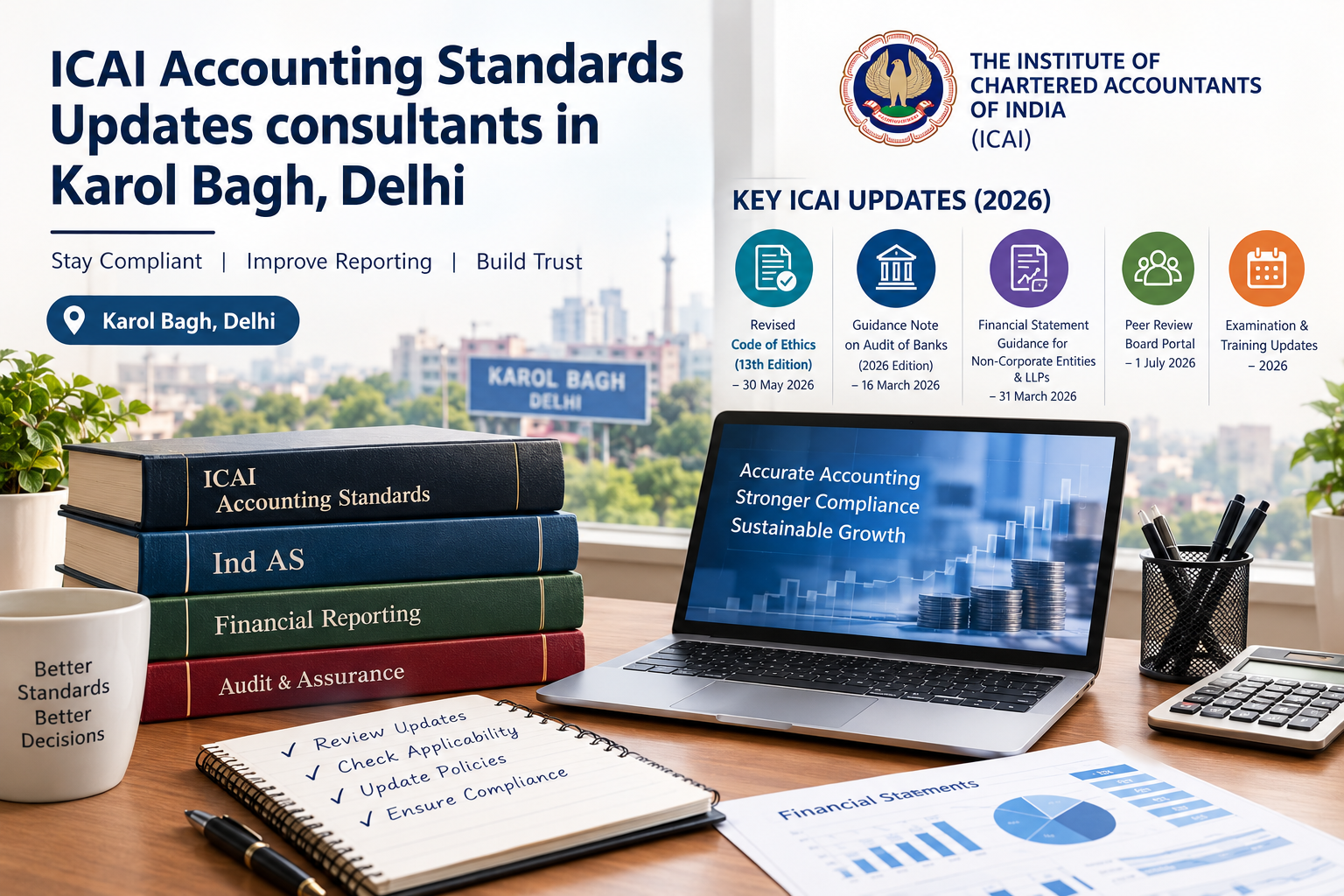
ICAI Accounting Standards Update Consultants in Karol Bagh, Delhi
Accounting standards play an important role in preparing reliable financial statements, maintaining transparent books of accounts and supporting regulatory compliance. Businesses, LLPs, finance teams and professional accountants need to monitor changes in accounting guidance to ensure that their reporting practices remain appropriate. ICAI Accounting Standards Updates consultants in Karol Bagh, Delhi is a relevant topic for businesses seeking professional guidance on accounting standards, financial reporting and the practical implementation of applicable requirements.
The Institute of Chartered Accountants of India (ICAI), through its Accounting Standards Board, publishes accounting guidance, announcements, educational resources and consultation documents. Recent developments include the phased applicability of financial-statement guidance for non-corporate entities and LLPs, resources relating to Ind AS and ongoing consultations on international accounting matters. Businesses should distinguish between mandatory requirements, ICAI guidance and draft proposals before changing their accounting policies.
For accounting, financial reporting and compliance-related information, visit Taxfiniti.
Key Takeaways
- ICAI’s Accounting Standards Board is an important source for accounting standards, financial reporting guidance and professional resources.
- ICAI announced phased applicability of its financial-statement guidance for non-corporate entities and LLPs from accounting periods beginning on or after 1 April 2025 and 1 April 2026, depending on the applicable category.
- Businesses should assess whether Accounting Standards (AS), Indian Accounting Standards (Ind AS) or another reporting framework applies to them.
- Proper documentation, reconciliations and consistent accounting policies can support reliable financial statements.
- Exposure drafts and consultation documents should not automatically be treated as final requirements.
- Businesses in Karol Bagh, Delhi, can benefit from reviewing accounting processes periodically and obtaining professional advice where the applicable framework is unclear.
1. What Are ICAI Accounting Standards Updates?
ICAI accounting standards updates refer to announcements, guidance notes, educational materials and other professional developments published by ICAI and its relevant boards. These resources help Chartered Accountants and businesses understand accounting and financial-reporting requirements.
However, it is important to distinguish between different types of publications.
Accounting standards and applicable rules
The accounting standards applicable to an entity depend on its legal form, size, regulatory status and other criteria. Certain accounting standards are prescribed or notified under the applicable legal framework, including rules issued by the Ministry of Corporate Affairs (MCA) for companies.
Guidance notes
Guidance notes explain accounting or reporting matters and help professionals apply relevant requirements. Their scope and status should be checked before treating a particular recommendation as mandatory.
Exposure drafts and consultation papers
Exposure drafts invite comments on proposed changes. They indicate that a matter is under consideration and do not necessarily represent a final requirement.
Educational resources
Webinars, FAQs, publications and professional courses help accountants understand accounting developments. These resources can support implementation but should be read alongside the applicable standards and legal requirements.
The official ICAI Accounting Standards Board page provides access to relevant announcements, resources and accounting-standard information. <Cite refs={[“turn938795search0”]} />
2. Important ICAI Accounting Updates for 2026
One significant development announced by ICAI in 2026 concerns financial-statement guidance for non-corporate entities and limited liability partnerships.
On 31 March 2026, ICAI announced phased applicability of its Guidance Note on Financial Statements of Non-Corporate Entities and Guidance Note on Financial Statements of Limited Liability Partnerships. <Cite refs={[“turn938795search1”]} />
Phase I: Accounting periods beginning on or after 1 April 2025
According to the announcement, Phase I applies to entities whose turnover exceeds ₹5 crore for accounting periods beginning on or after 1 April 2025, subject to the scope and conditions in the official guidance.
Eligible entities should review their financial-statement preparation processes and assess whether the guidance applies to their reporting period.
Phase II: Accounting periods beginning on or after 1 April 2026
The announcement specifies Phase II applicability to all entities covered by the guidance for accounting periods beginning on or after 1 April 2026.
Businesses should read the official announcement carefully to understand its scope and any applicable conditions. The reporting framework for an individual entity must still be determined using the relevant rules and facts.
What should businesses do?
Businesses and LLPs should consider the following practical steps:
- Confirm their legal structure and applicable accounting framework.
- Review the financial-statement guidance relevant to their entity category.
- Examine existing accounting policies and reporting formats.
- Check whether disclosures need to be updated.
- Maintain supporting documents for balances, estimates and significant transactions.
- Seek clarification where the applicability of the guidance is uncertain.
Official announcement: ICAI — Applicability of Financial-Statement Guidance for Non-Corporate Entities and LLPs. <Cite refs={[“turn938795search1”]} />
3. Accounting Standards (AS) vs Indian Accounting Standards (Ind AS)
One of the first steps in accounting compliance is identifying the correct reporting framework. Accounting Standards (AS) and Indian Accounting Standards (Ind AS) are not interchangeable labels for a single set of requirements.
Their applicability depends on the type of entity and the relevant legal and regulatory criteria.
Accounting Standards (AS)
Accounting Standards may be relevant to entities covered by the applicable framework for AS. The entity must determine which standards and requirements apply to its financial statements.
Indian Accounting Standards (Ind AS)
Ind AS applies to entities within its prescribed scope. Companies should check the applicable MCA rules and any relevant amendments to determine their reporting obligations.
Ind AS includes detailed requirements on topics such as revenue recognition, leases, financial instruments, employee benefits and presentation of financial statements.
Why correct classification matters
Using the wrong reporting framework can result in inappropriate accounting treatment or disclosures. Before finalising financial statements, businesses should establish which requirements apply to their legal structure and reporting period.
ICAI provides professional resources, publications and educational programmes on accounting standards through its Accounting Standards Board and publication portal. <Cite refs={[“turn938795search0″,”turn938795search5”]} />
4. How Accounting Standards Affect Financial Statements
Accounting standards influence how financial information is recognised, measured, presented and disclosed. Their practical effect depends on the standard and the transactions involved.
Recognition of income and expenses
Businesses need appropriate policies for recording income and expenses in the relevant accounting period. The correct treatment depends on the nature of the transaction and the applicable requirements.
Valuation of assets and liabilities
Accounting requirements may affect the measurement of property, equipment, investments, receivables, provisions and other balances. Reliable supporting records help explain the figures presented in the financial statements.
Presentation and disclosure
Financial statements should present material information in accordance with the applicable reporting framework. Required disclosures may include accounting policies, significant estimates, related-party information or other details, depending on the entity and relevant standard.
Consistency between reporting periods
Consistent accounting policies can make financial statements easier to compare across periods. Where a policy change is necessary or required, its treatment should follow the applicable accounting rules.
Professional review can help businesses identify inconsistencies and determine whether additional documentation or disclosures are needed.
5. Practical Accounting Compliance Checklist for Businesses
Businesses in Karol Bagh and across Delhi can use a structured process to review accounting compliance. The checklist should be adapted to the entity’s size, activities and applicable reporting framework.
Review the accounting framework
Confirm whether the business is a company, LLP, partnership, proprietorship or another type of entity. Determine the accounting standards and financial-statement guidance that apply.
Reconcile financial records
Reconcile bank accounts, receivables, payables, loans, inventory and other significant balances with supporting records.
Review accounting policies
Check whether the policies used for income recognition, depreciation, provisions and other material items remain appropriate under the applicable standards.
Verify supporting documentation
Maintain invoices, contracts, bank statements, ledgers and other records that support material balances and transactions.
Examine financial-statement disclosures
Review whether the statements contain the disclosures required under the applicable framework.
Maintain a record of changes
Keep a record of the standards, guidance and official announcements considered when making significant accounting decisions. This helps explain the basis for the accounting treatment adopted.
These steps are general good practices. The precise requirements should be determined under the standards and rules applicable to the entity.
6. Why Professional Accounting Guidance Can Be Useful
Accounting requirements can be complex when a business changes its legal structure, expands its activities, enters into new transactions or prepares financial statements under a different reporting framework.
Professional guidance may help a business understand its obligations and implement appropriate procedures.
Identifying applicable standards
A professional review can help establish which standards and financial-reporting requirements apply to a particular entity.
Reviewing accounting policies
Accounting policies may need to be reviewed when the business introduces new products, services, contracts or financing arrangements.
Improving reconciliations and documentation
A structured review can identify incomplete reconciliations, unsupported balances and inconsistencies in the underlying records.
Supporting financial-statement preparation
Businesses may require assistance with financial-statement preparation, disclosure review and coordination of accounting records.
Preparing for audit or review
Organised records and documented accounting decisions can make it easier to respond to questions raised during an audit or other professional review.
The scope of any professional engagement should be agreed in advance. Businesses should not assume that every accounting consultant provides statutory audit services or can certify all types of financial statements.
For information about accounting and financial services, visit https://taxfiniti.com/.
7. Accounting Standards and LLPs
LLPs have their own legal structure and reporting considerations. Their accounting and financial-statement obligations should be assessed under the applicable law and relevant ICAI guidance.
ICAI’s 31 March 2026 announcement specifically addresses phased applicability of its Guidance Note on Financial Statements of Limited Liability Partnerships. <Cite refs={[“turn938795search1”]} />
An LLP should consider:
- The accounting period covered by the guidance.
- Whether it falls within the relevant phase.
- Its existing financial-statement preparation process.
- The adequacy of supporting accounting records.
- The presentation and disclosure requirements applicable to its circumstances.
An LLP should not automatically apply the reporting rules for a company without first checking which framework governs its financial statements.
8. Understanding Accounting Updates and Proposed Changes
Accounting professionals regularly encounter draft amendments, international consultations and educational announcements. Correctly identifying the status of each document is essential.
For example, ICAI’s Accounting Standards Board publishes consultation material relating to international accounting developments. Such documents can invite stakeholders to provide comments before the relevant standard-setting process reaches a final outcome. <Cite refs={[“turn938795search2″,”turn938795search3”]} />
Before acting on an update, ask:
- Is this a final standard, formal notification, guidance note or exposure draft?
- Which entities and reporting periods are covered?
- Is the document applicable in India, or is it an international consultation?
- Has a final amendment or implementation date been announced?
- Are there subsequent clarifications or transitional provisions?
This process helps prevent a proposal from being incorrectly treated as an existing mandatory requirement.
9. How to Track ICAI Accounting Standards Updates
Businesses and accounting professionals can follow a simple monitoring process.
Step 1: Visit the official ICAI Accounting Standards Board page. Review new announcements, guidance notes, FAQs and other accounting resources.
Step 2: Check the publication date. Confirm that the document relates to the relevant reporting period.
Step 3: Read the original document. Headlines and summaries may not explain every condition or exception.
Step 4: Verify the applicable framework. Check the entity category, legal requirements and reporting obligations.
Step 5: Record any required action. If an update applies, document the changes needed to accounting policies, disclosures or internal procedures.
Step 6: Recheck for clarification. Review subsequent ICAI or relevant regulatory announcements before finalising a material accounting decision.
The primary source is the official ICAI Accounting Standards Board page. <Cite refs={[“turn938795search0”]} />
10. Choosing Accounting Standards Updates Consultants in Karol Bagh, Delhi
Businesses looking for ICAI Accounting Standards Updates consultants in Karol Bagh, Delhi should focus on the professional support required and the consultant’s relevant experience.
Consider these points when evaluating an accounting professional or consultancy:
- Relevant expertise: Experience with the entity’s accounting framework and financial-reporting requirements.
- Clear scope of work: A written description of the review, documentation and reporting services to be provided.
- Knowledge of official guidance: A process for checking current ICAI announcements and relevant regulatory requirements.
- Practical implementation: Ability to explain what an update means for the business’s records and reporting process.
- Documentation standards: A clear approach to maintaining supporting records and explaining accounting decisions.
- Transparent communication: Clear discussion of deliverables, timelines, fees and any limitations of the engagement.
The right scope of support depends on the entity’s circumstances. A small business may need help identifying its applicable reporting requirements, while an LLP or larger entity may require a more detailed financial-statement review.
For information about available services, visit Taxfiniti.
Conclusion
ICAI accounting standards updates are important for businesses and accounting professionals who want to maintain reliable financial records and comply with the requirements applicable to their entity. The 2026 announcement on phased applicability of financial-statement guidance for non-corporate entities and LLPs is a key development that eligible businesses should review carefully.
The practical approach is to identify the correct accounting framework, read the official guidance, confirm the effective period and document any required changes. Businesses in Karol Bagh, Delhi, can use a structured accounting review to identify reporting gaps and improve the quality of their financial information.
For more information about accounting and financial services, visit https://taxfiniti.com/.