
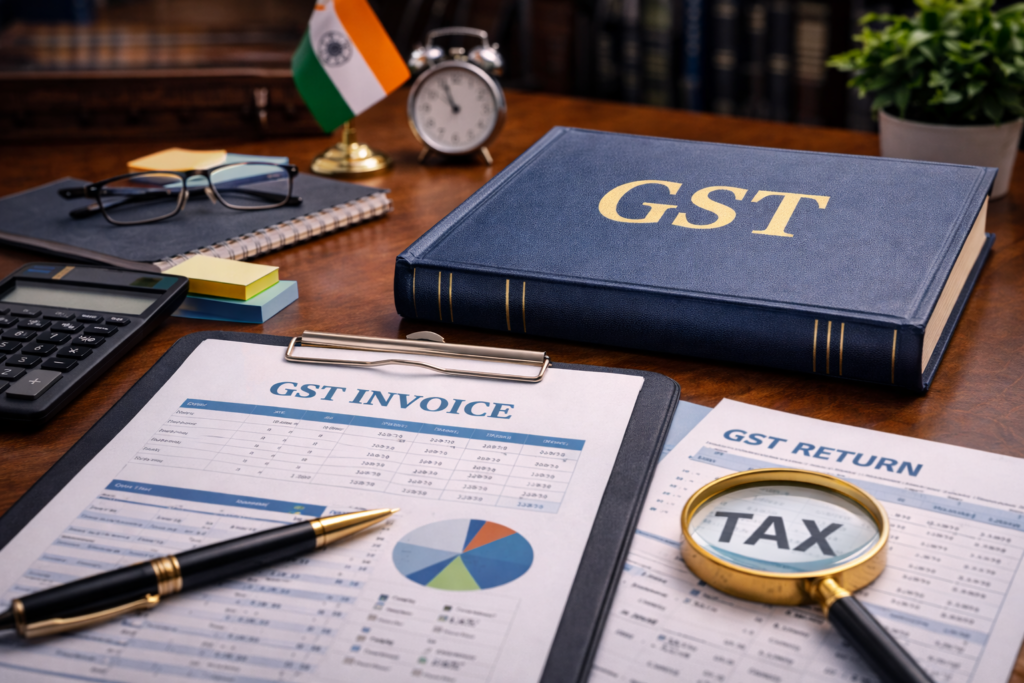
The Goods and Services Tax (GST) is a landmark reform in India’s taxation system, introduced to simplify indirect taxes, ensure uniformity, and promote ease of doing business. Implemented on July 1, 2017, GST replaced multiple indirect taxes such as VAT, Service Tax, Excise Duty, and CST, creating a single, unified tax system across the country.
Understanding GST in India
GST is a consumption-based tax levied on the supply of goods and services. It is classified into three main types:
- CGST (Central GST): Collected by the central government on intra-state sales.
- SGST (State GST): Collected by the state government on intra-state sales.
- IGST (Integrated GST): Collected by the central government for inter-state sales, later shared with the destination state.
GST follows a destination-based tax system, meaning the tax revenue goes to the state where the goods or services are consumed rather than the state where they are produced.
Importance of GST for Businesses
GST has transformed business operations and compliance in India in multiple ways:
- Simplification of Tax Structure: Replacing multiple taxes with a single tax reduces complexity in tax calculations and accounting.
- Input Tax Credit (ITC): Businesses can claim credit for taxes paid on purchases, reducing the cascading effect of taxes.
- Transparency: GST promotes clear invoicing and standardized compliance procedures.
- Ease of Doing Business: Unified tax rates and online filing simplify operations, particularly for multi-state businesses.
- Economic Growth: GST encourages formalization of businesses and improves tax compliance, contributing to broader economic efficiency.
Key Components of GST Compliance
1. Registration
Businesses with turnover exceeding the threshold limit must register for GST. Registration ensures the business can legally collect GST, claim ITC, and file returns. Special schemes like Composition Scheme are available for small businesses with lower compliance requirements.
2. Invoicing and Tax Collection
GST-compliant invoices must include details such as GSTIN, HSN/SAC codes, applicable tax rates, and total amounts. Accurate invoicing ensures proper tax collection and helps in claiming input tax credit.
3. Filing GST Returns
Regular filing of returns is mandatory under GST. These include:
- GSTR-1: Details of outward supplies.
- GSTR-3B: Monthly summary return for tax payment.
- GSTR-9: Annual return for reconciliation of accounts.
Timely and accurate return filing prevents penalties and maintains compliance credibility.
4. Input Tax Credit (ITC)
ITC allows businesses to reduce their GST liability by claiming credit on tax already paid on purchases. Proper documentation and reconciliation of purchase and sales records are essential to maximize ITC benefits and avoid disputes.
5. GST Audit
Businesses with turnover exceeding Rs. 2 crore are required to conduct a GST audit, either by a Chartered Accountant or a Cost Accountant. The audit ensures that all tax liabilities are properly accounted for and that ITC claims are valid.
Challenges in GST Compliance
- Complex Filing Procedures: Multiple return forms and frequent updates can be confusing for businesses.
- Matching of Invoices: Errors in supplier invoices can delay ITC claims.
- Classification Issues: Determining correct HSN/SAC codes for goods and services may be challenging.
- Timely Payment: Businesses must ensure GST payments are made within due dates to avoid interest and penalties.
Despite challenges, proper guidance and use of technology can make GST compliance smooth and efficient.
Benefits of GST for Businesses and the Economy
- Reduces Tax Cascading: Avoids the “tax on tax” effect, lowering overall costs.
- Promotes Digital Compliance: Online registration, invoicing, and filing enhance transparency and accountability.
- Increases Competitiveness: Uniform tax rates across states reduce cost disparities.
- Encourages Formal Economy: More businesses enter the formal system, improving credit access and market growth.
- Simplifies Inter-State Trade: IGST enables seamless interstate transactions without multiple taxation layers.
Role of Technology in GST Compliance
- GSTN Portal: Centralized platform for registration, invoicing, and return filing.
- Accounting Software Integration: Automates tax calculations, invoicing, and return filing.
- Data Analytics: Helps identify discrepancies, pending ITC claims, and compliance gaps.
- Digital Records: Reduces errors, facilitates audits, and ensures better documentation.
By leveraging technology, businesses can reduce compliance costs, prevent errors, and make informed financial decisions.
Expert Guidance and EEAT Principles
GST compliance is complex and requires expertise in tax laws, accounting standards, and technology tools. Consulting certified tax professionals, Chartered Accountants, or GST consultants ensures:
- Accurate return filing
- Proper utilization of ITC
- Avoidance of penalties
- Legal compliance with latest updates
Following EEAT principles, guidance from authoritative sources builds trust, minimizes errors, and supports business growth.
Conclusion
GST has revolutionized India’s indirect tax system, simplifying compliance, promoting transparency, and improving the business environment. From registration and invoicing to ITC claims and audits, businesses need systematic processes and expert guidance to navigate GST efficiently.
Proper GST management not only ensures legal compliance but also strengthens financial planning, operational efficiency, and stakeholder confidence. By understanding GST thoroughly, businesses can leverage its benefits for long-term growth and economic sustainability.